Bhutan
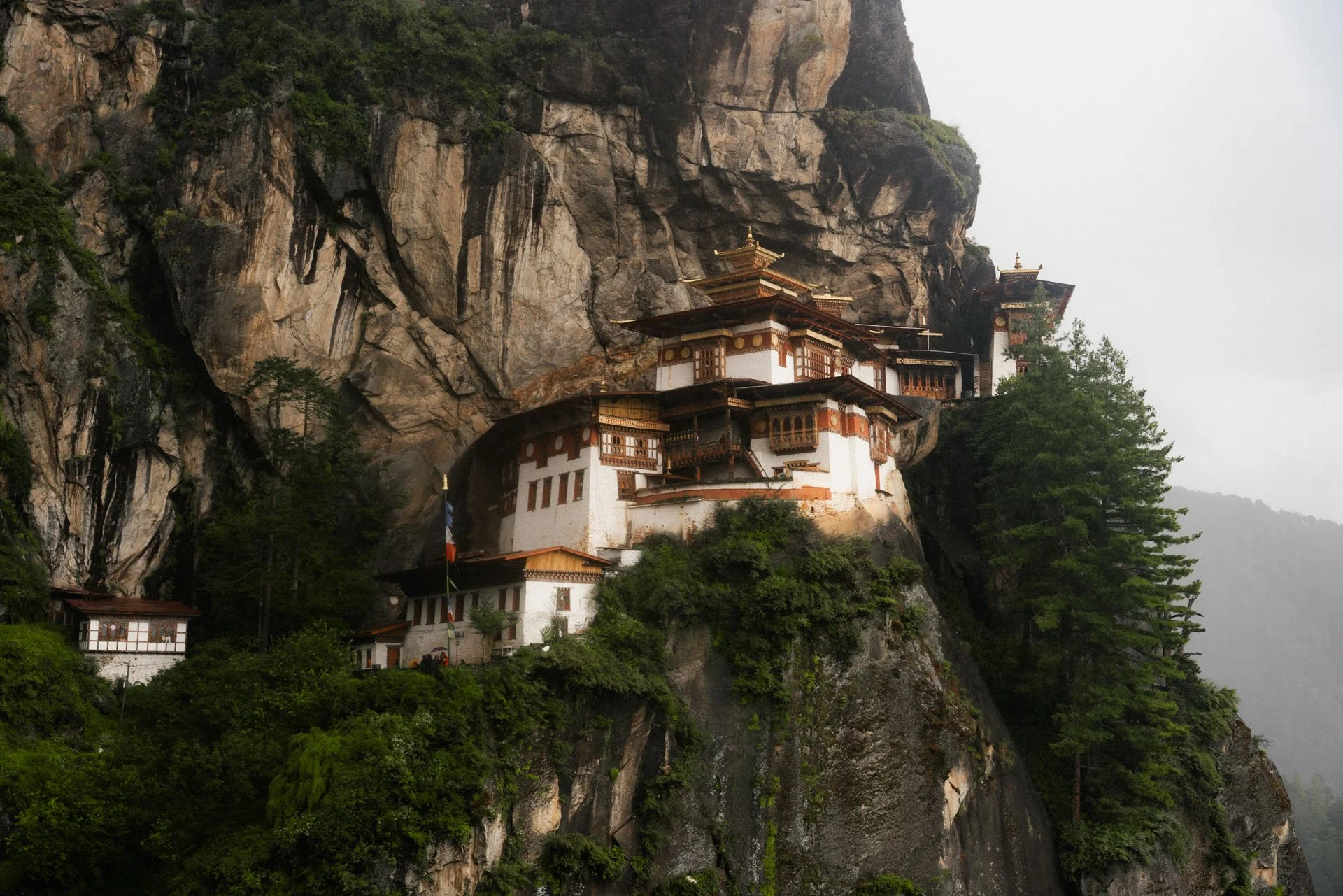
The stunning Tiger's Nest Monastery (Paro Taktsang) clings to a cliffside in Bhutan. Photo: Alex Pflaum
I. Orientation
Bhutan introduced television in 1999. That fact landed in my body before it landed in my mind.
I was standing in cold morning air outside a monastery, incense smoke clinging to my clothes, monks chanting in a low register that vibrated through my chest. Prayer flags snapped sharply in the wind. Yak butter tea left a faint oil on my lips. And I kept thinking: this culture learned who it was before it learned how to broadcast itself.
Bhutan was among the last countries to formally allow television. Not because it couldn’t access it. Because it chose not to. Leaders worried about cultural erosion, social fragmentation, and the quiet unraveling of values that take centuries to cultivate and only years to dissolve.
I came here as design research for YONDER, drawn by Gelephu Mindfulness City, a future city imagined not as spectacle or techno salvation, but as something far stranger: an attempt to weave spirituality, ecology, and prosperity into a coherent whole.
If projects like NEOM emerge from the worldview of their cultural field, then this question wouldn’t leave me alone: What kind of field makes something like Gelephu possible?
This pilgrimage was made with a small group of designers, artists, and creatives curated by Collins and facilitated by Abroad. Getting here was intentionally difficult. A daily Sustainable Development Fee. Layers of permission. Physical remoteness enforced by mountains themselves. This is a country shaped by boundaries. And I would come to feel that those boundaries were doing invisible work.
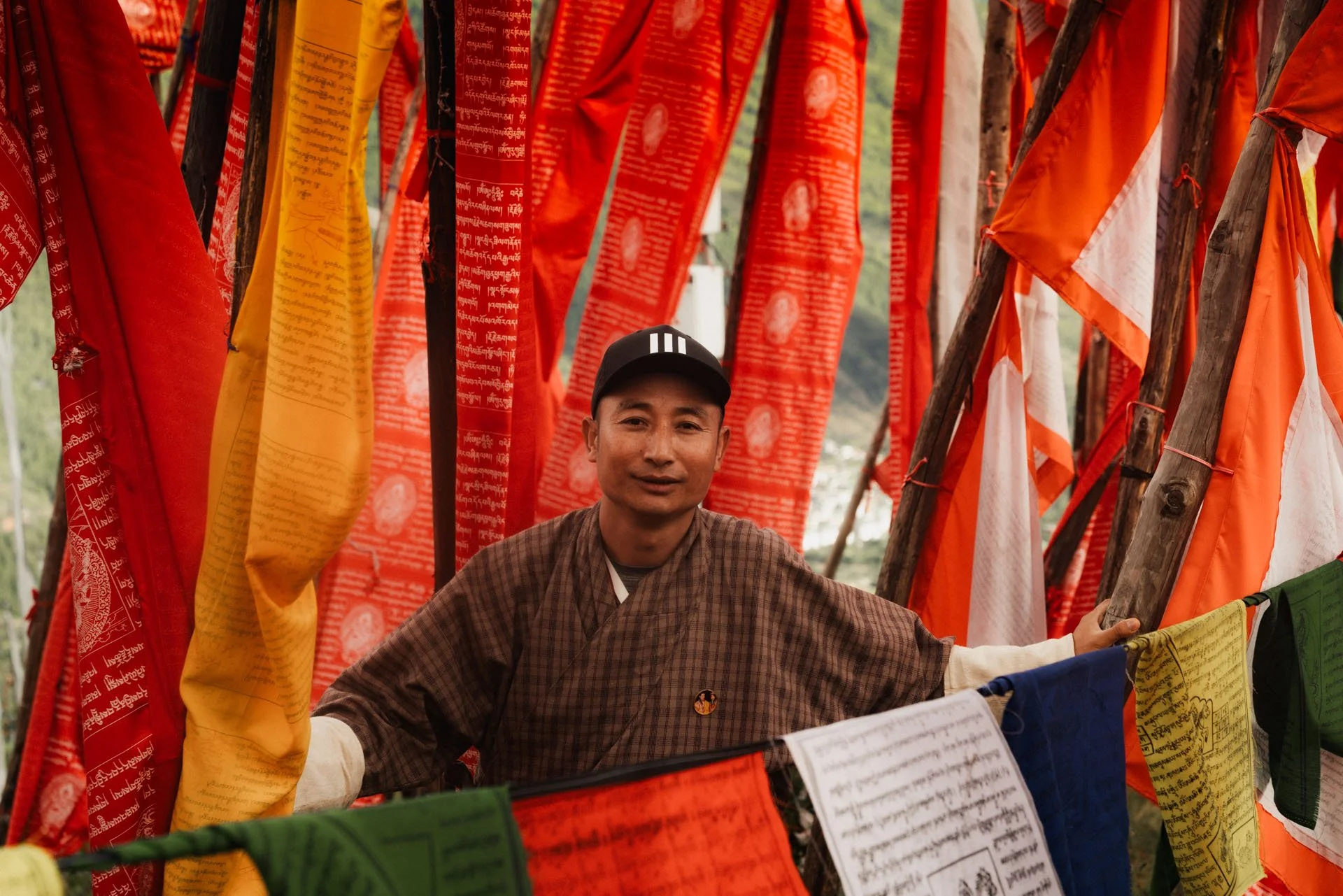
Woven into the wind: Our guide, Kinley, stands among the fluttering prayers of Bhutan. Photo: Alex Pflaum
II. What the Field Revealed
Bhutan announces itself through the senses first.
Drums. Low horns. The crackle of incense catching flame. Monks chanting for hours without urgency. Ceremonies as ongoing rhythms of daily life.
Wild dogs roam freely everywhere. They nap in temple courtyards, wander streets, curl up near cafés. I never once heard one bark.
They are not truly ownerless. They belong to the place. No single person claims them, yet people feed them, look out for them, make room for them. Care is distributed rather than assigned.
Their gentleness felt like a clue. Watching them, I realized I was seeing the same logic that governs much of life here.
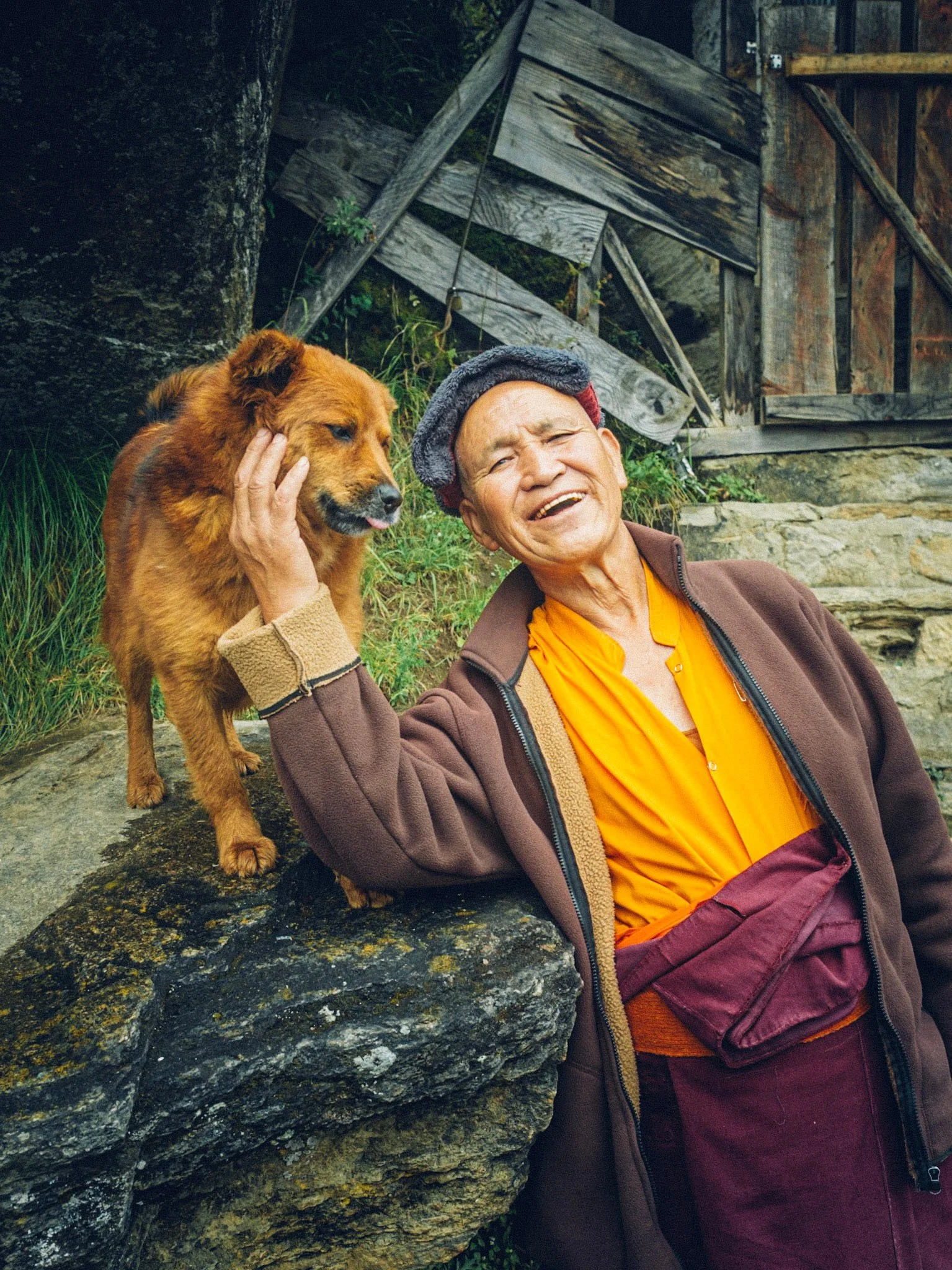
Trailside smiles and a furry friend on the path to Paro Taktsang Monastery. Photo: Ian Haigh
We moved through spaces that felt less like destinations and more like living organs of the culture.
We climbed to Tiger’s Nest with lungs burning in thin air, the path winding upward through pine and rock. Inside, we descended into the caves where Guru Padmasambhava is said to have meditated centuries before the temple was built around them.
It was quiet and reverent. You could feel the weight of attention placed there, again and again, long before form arrived to contain it.
We were welcomed not as tourists but as guests. A reincarnated Rinpoche blessed us. We participated in rituals clearly not designed for display.
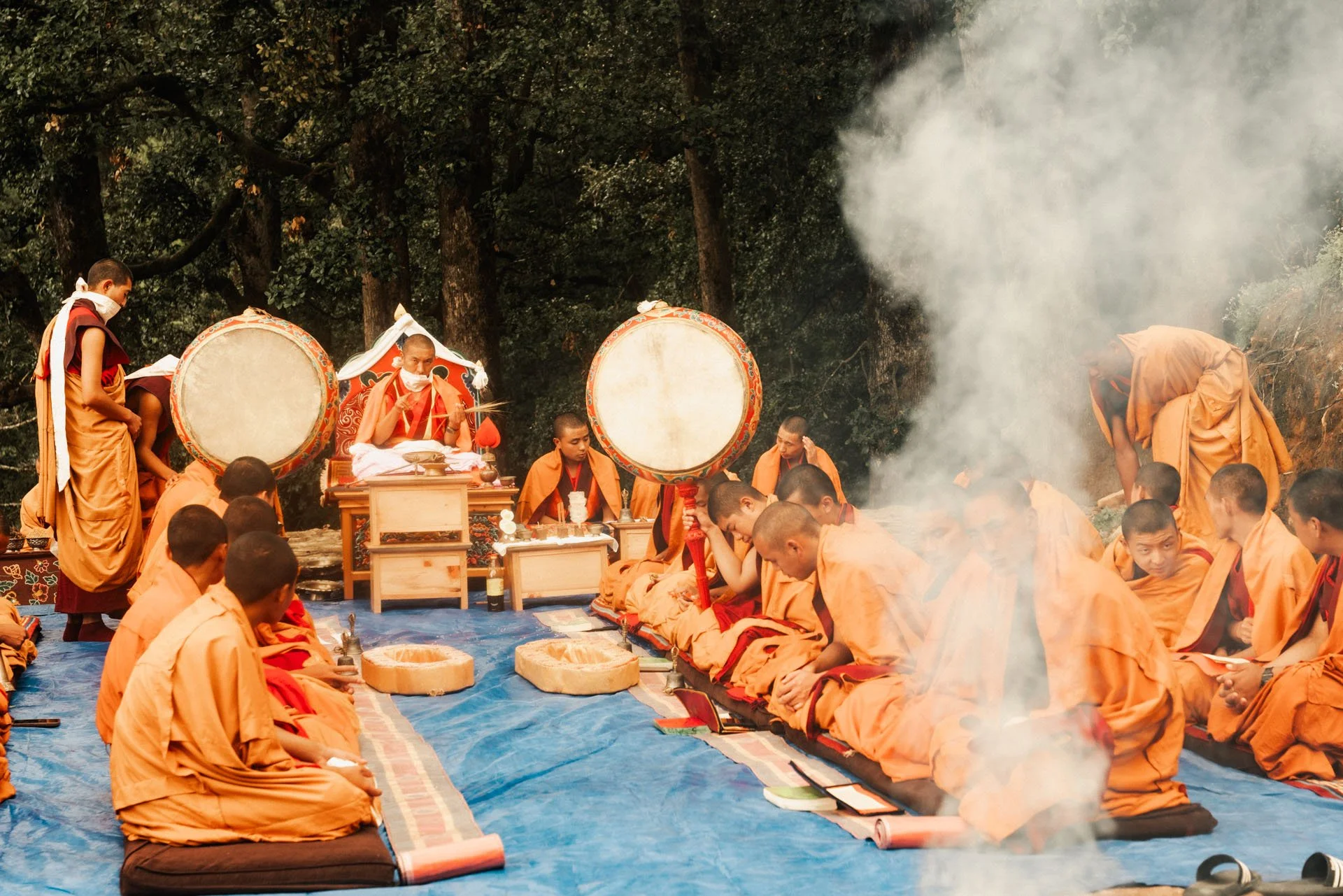
The purification ceremony unfolds at Dodeydra, filled with the rich sounds of drums, horns, and spiritual chanting. Photo: Alex Pflaum
At one point, we spent an hour in conversation with the King of Bhutan himself, speaking candidly about Gelephu and the tightrope the project must walk—honoring tradition and spiritual life while creating material prosperity and opportunity.
We encountered the King on several occasions during our time there. And just as telling was how people spoke of him when he wasn’t present.
There was no performative reverence. People trusted him.
He spoke openly about his greatest fear: that he might fail his people through this project. His hope was that Gelephu could become a prototype, not just for Bhutan, but for other places searching for a different path forward.
Watching how people oriented toward him, I felt something unfamiliar. What becomes possible when leadership is broadly trusted and collective energy isn’t spent in constant internal opposition? When governance isn’t adversarial, attention can move forward rather than fracture inward.
I realized I was observing trust as an enabling condition.
Trust appears in small, bodily ways. I had to retrain my nervous system to leave my bag unattended—in a van, on a bench, outside a café. No one would steal it, my guide insisted. ‘The Moelam wouldn’t be worth it.’
Moelam is often translated as karma, but that feels insufficient. It is spoken of more like a moral bank account. Something accumulated through intention, action, and relationship. Guides explained that if people connect easily in this life, it may be because of good Moelam carried from previous ones.
What struck me was how functional this idea is. Not philosophical. Not symbolic.
In everyday Bhutanese life, Moelam is treated as causal. Something that actively shapes conditions. Inner states are not considered private here; they are infrastructural. Prayers are believed to influence karmic conditions, strengthen social coherence, and maintain harmony between human and non-human realms.
This shapes behavior.
One of our guides shared his dream of studying abroad to pursue a career that could provide abundance for him and his family. Wanting to support him, I tipped him generously, assuming the money would go toward logistics or tuition. Later, I learned he used it to buy a statue of the god of prosperity so he could pray. To him, this was the most practical choice available. That moment quietly dismantled my own assumptions about pragmatism.
I realized Moelam is not about reward or punishment. It is about stewarding the invisible conditions that make certain futures more likely than others. A form of stored relational potential, tended collectively, long before outcomes arrive.
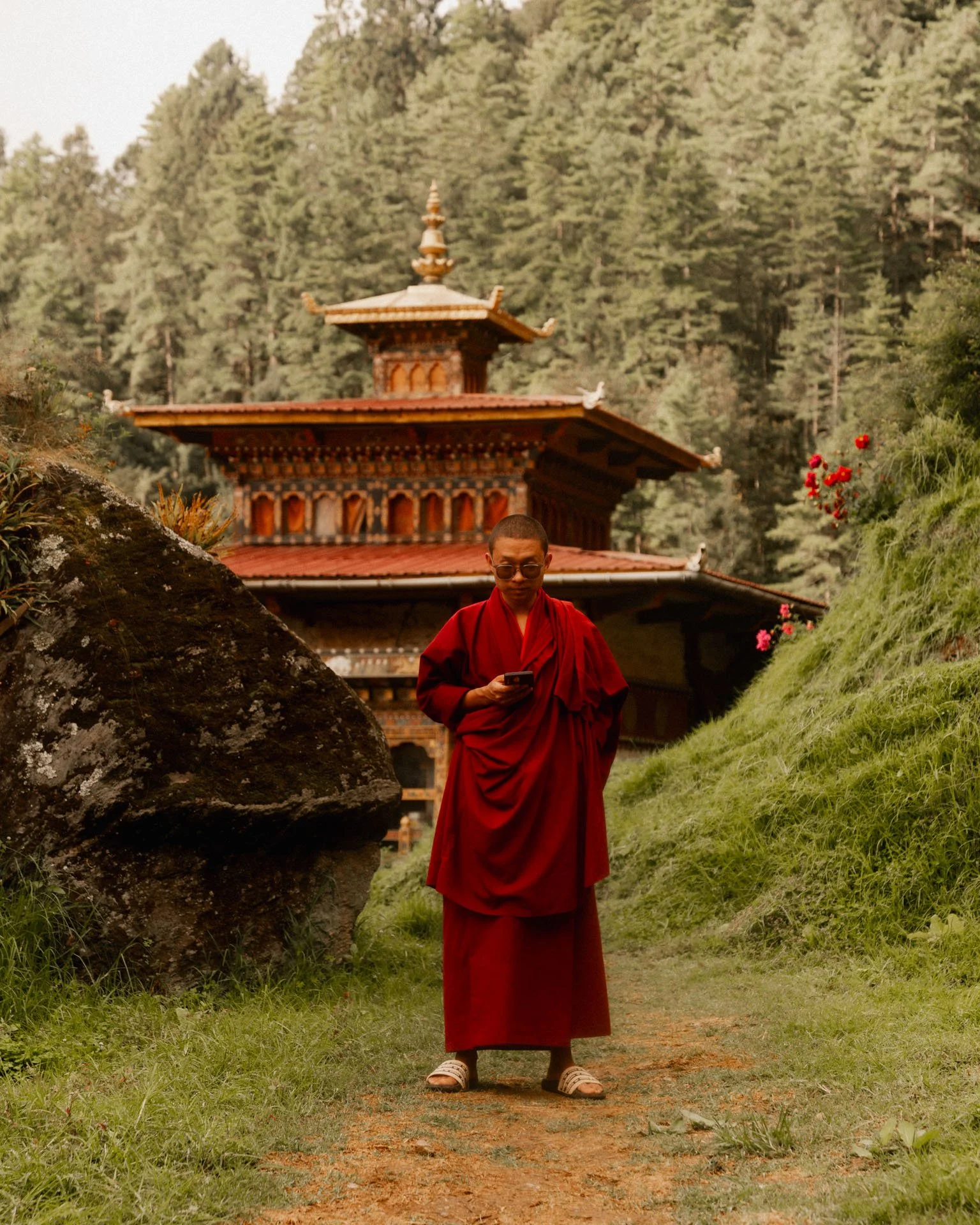
The timeless search for wisdom meets the modern-day scroll. Photo: Alex Pflaum
III The Pattern Beneath
The dominant emotional tone I felt here wasn’t peace or happiness.
It was intent.
Actions felt tethered to a why. Ceremonies weren’t symbolic performances. They were infrastructure. Chanting, ritual, Moelam—these are not personal wellness practices. They are social glue. What I began to see was not just belief, but a shared mechanism. An enduring way of coordinating behavior and responsibility without constant enforcement.
Bhutan spent centuries cultivating spiritual and cultural infrastructure before attempting to scale material systems. The mountains act as guardians. Physical boundaries slowed extraction and acceleration. Intentional decisions, like postponing television, allowed cultural coherence to form before exposure. Everywhere, there is visible evidence of a living cosmology woven into daily life. And when television finally arrived, Bhutan didn’t just adopt it. They studied its effects. What they noticed was subtle but consequential: Individuals enjoyed it. Communities quietly lost something.
Attention bent inward. Shared rhythms loosened. Time once spent together fragmented into parallel private worlds. None of this happened dramatically. It happened gradually, almost politely. This wasn’t framed as moral failure. It was treated as information. Signal from the field.
In Bhutan, the health of the community has long been held as primary. Individual pleasure matters, but not at the expense of collective coherence. That ordering, community before individual, is nearly the inverse of the cultural logic I come from. As a designer, this realization landed heavily.
Bhutan did not begin by asking, what should we build? It asked, who must we be before we build anything at all?
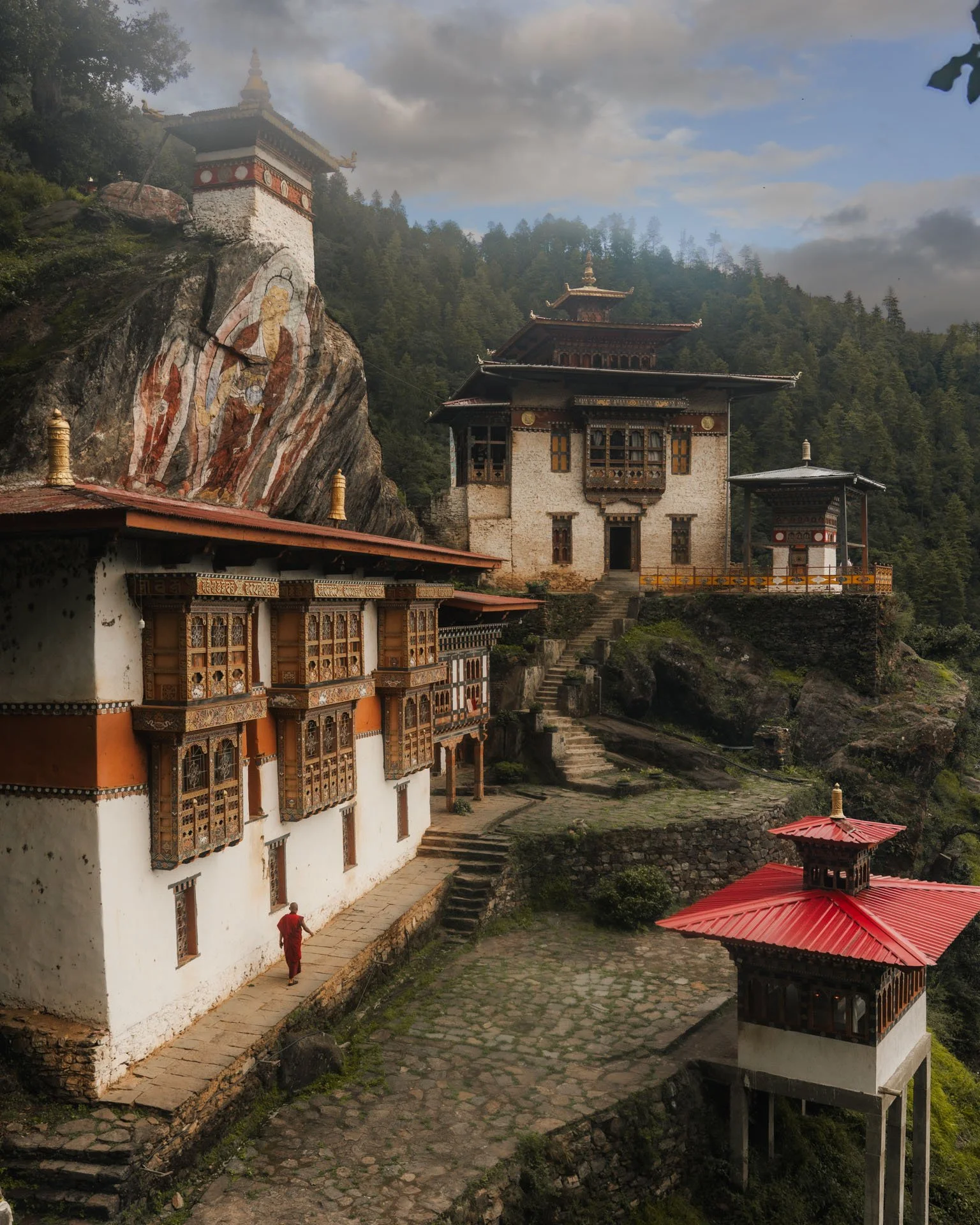
A monk walks along the path at the Dodeydra Monastery, nestled in the mountains above Thimphu, Bhutan. Photo: Alex Pflaum
IV. The Questions That Remain
What does it look like to build the field first, before we ask it to hold what comes next?
Bhutan delayed television until it had centuries of coherence behind it. And even then, it watched closely for what would happen to the social fabric once attention could be pulled into private worlds.
Today, much of the world is rushing headlong into AI, immersive media, and synthetic realities, technologies that do not simply entertain individuals but can reorganize culture itself. They will change what we notice, what we value, what we share, and what we do alone.
So I’m left with a question that refuses to resolve: What kinds of cultural, spiritual, and relational infrastructure must exist before a society can integrate tools that reshape attention and belonging?
And more personally, as I consider what YONDER is really designing for: How do we create experiences that strengthen collective coherence in an age that relentlessly optimizes for the individual?
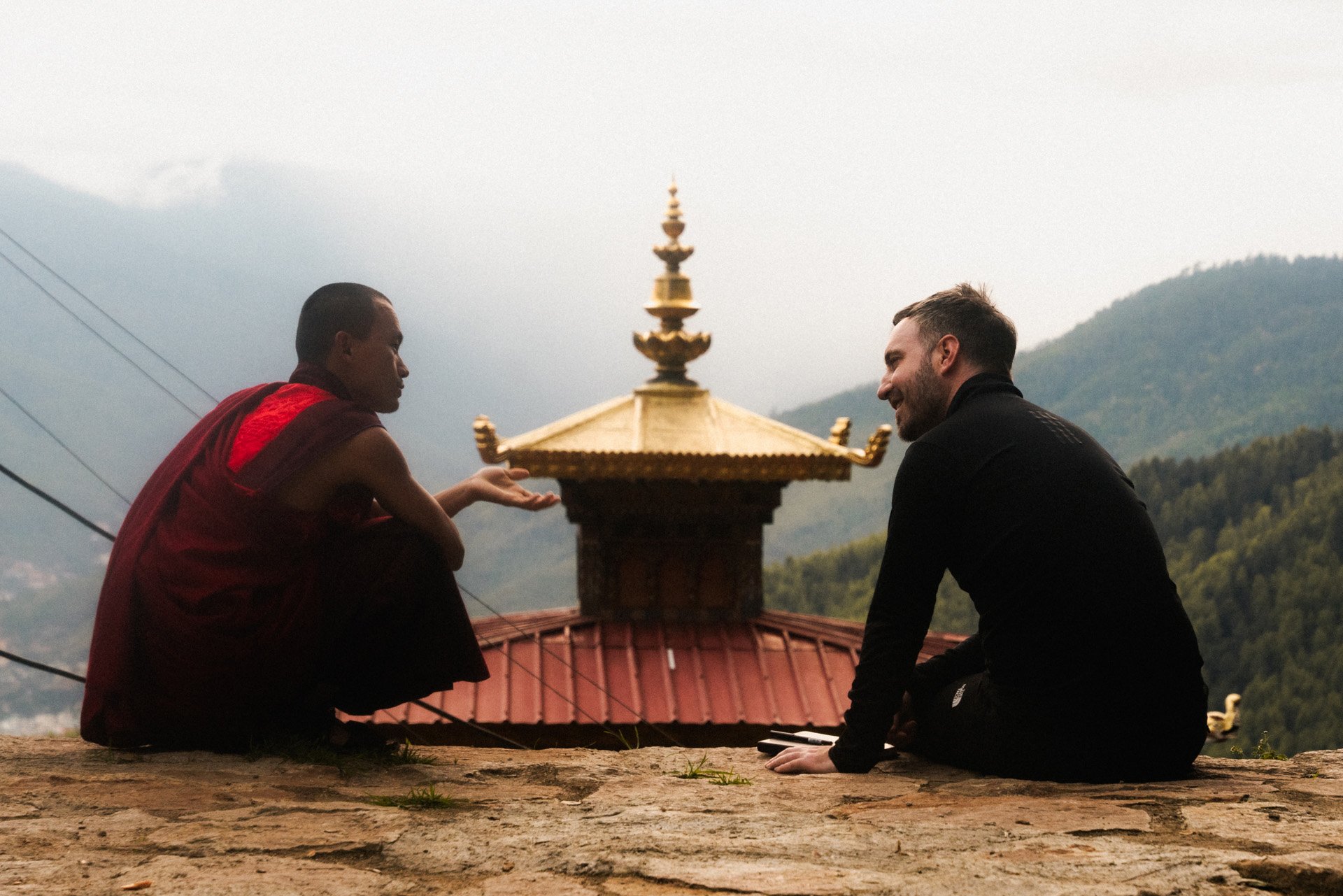
The pursuit of understanding transcends all borders. Photo: Alex Pflaum
Each Field Note emerges from time spent in a specific place, and from attention paid to the visible and invisible fields that shape what becomes possible there. They are offered not as answers, but as signals.